

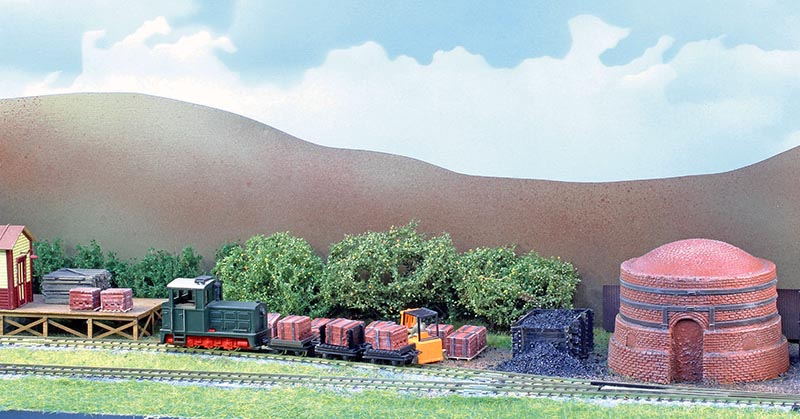
HOn30 Mini layout inspired by the Palmetto Brick Company
 by George Riley/photos by the author except as noted
Among the many industries that relied on narrow gauge industrial railroads brick manufacturing is near the top of the list. While today over-the-road trucks and conveyor belts have taken over from these rail operations, up until 2010 when the last train ran on the three-foot gauge tracks to the Palmetto Brick Company located in Wallace, S.C., clay was delivered from the pits to the mold house on rails.
Palmetto Brick had a roster of two Plymouth two-axle diesel locomotives, one built in 1939 ,and the other in 1946, which had replaced previous steam power. Along with three sets of Western Wheeled Scrapper Co. steel-bodied, four-wheel side dump cars, they hauled loads of clay from the company’s clay pit to the brick works on multiple daily runs, running locomotive first to the plant and then pushing a rake of empty cars back to the pits. At the mold house, a cable and winch pulled the cars into the building for unloading. Once unloaded. the empty cars were rolled down grade by gravity to be coupled to the next available locomotive. The operation was simplicity itself.
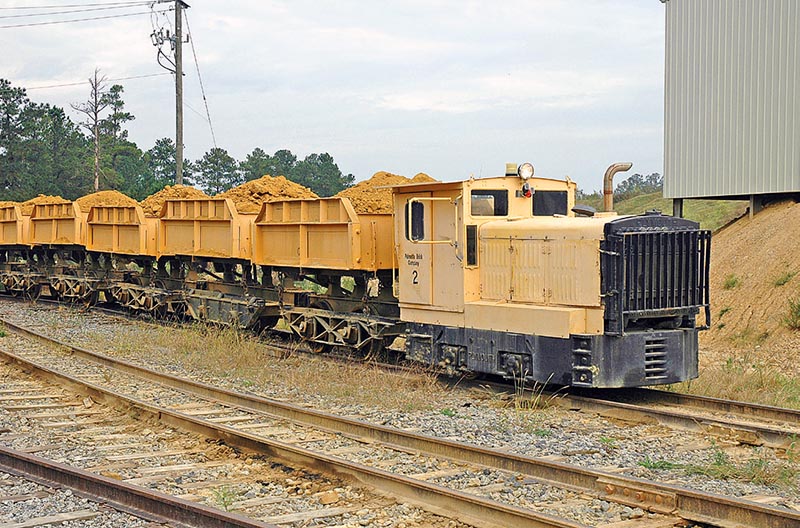
ABOVE: Palmetto Brick railroad in operation. The line had two Plymouth diesels and strings of side dump cars. —Craig Walker photo
Based on this prototype with its small locomotives and roster of four-wheel cars, the concept for the Blue Ridge Brick layout was formed. Taking advantage of HOn30 industrial rolling stock’s ability to negotiate sharp curves and its need for only limited space, a design for a two-foot by four-foot layout was conceived based on four T-Trak style sections that would easily fit on a fold up 2×4 table. The two end sections with the return curves were 11″ x 24″ and the straight sections were 245⁄16″ x 10″.
On one side of the layout a pair of Skytrex HO scale resin brick kilns with chimney were located beside a spur which connected with a 6″ radius (no. R150-45) on one of the end sections. This interior curve passes under a loading tipple which is a repurposed Suydam/Alpine Models Black Bart Mine before disappearing behind a retaining wall and under a hill.
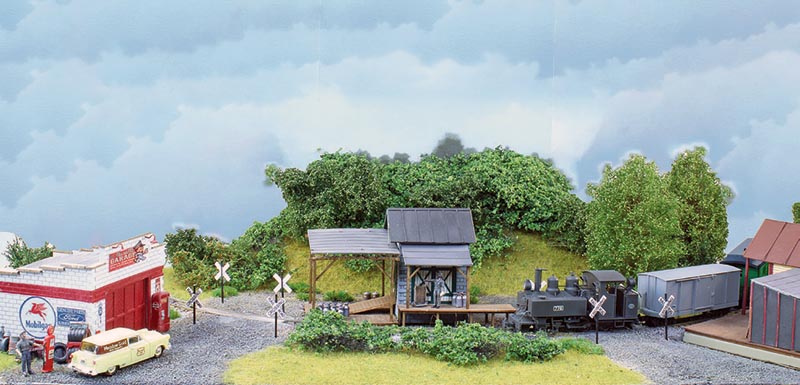
ABOVE: A weekend railfan excursion passes by a small hamlet which lies between the brick works and the kilns.
The straight section on the side opposite the kilns features the mold house assembled from an ancient craftsman kit purchased at a train show. Its origins are lost to the sands of time. Any shed large enough to provide clearance for a train of HOn30 dump cars and a four-wheel diesel locomotive can be pressed into service.
Outside of the mold house is a spur track that serves as a drying yard and is also used for storage for fired brick returned from the kilns. The end section opposite the loadout section is finished as a small trackside hamlet with a local garage, station/railroad office, and supply house. These structures were constructed from several Bar Mills basic kits and had additional third-party details added…
