

 by Johnny Graybeal/photos by the author
The East Tennessee & Western North Carolina Railroad, arguably the most famous narrow gauge line in the Southeastern United States, was a legend in its own time. Serving the region its name implies for almost 70 years, the ET&WNC and a sister company, the Linville River Railway, ran almost 70 miles into the western North Carolina mountains. It opened up an area to industry and tourism that is a tourist mecca to this day.
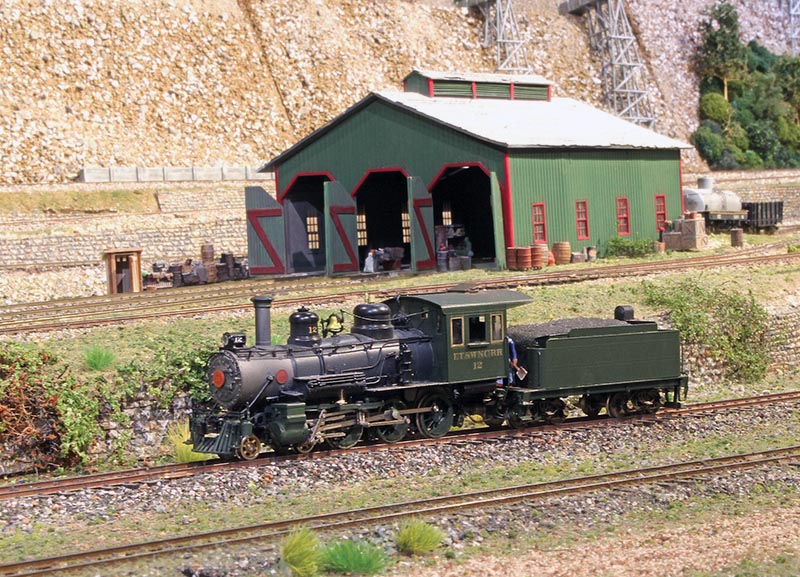
Modeling this iconic line has been a struggle but that situation has changed. With the advent of 3-D printing, a world of possibilities for modeling the ET&WNC/LR system is now open to us. For the first time an HOn3 modeler is able to model the railroad accurately, using all commercially available rolling stock. This article covers the entire history of the railroad, their locomotives, passenger cars, and freight cars. Considering that the railroad owned over 300 freight cars over the years, this story will concentrate on the train elements only. Depots, water tanks, and other items are also available in HOn3 for those interested in modeling this system.
Detailed rosters of the locomotives were in semi-recent issues of the Narrow Gauge & Shortline Gazette, the passenger car roster was in the 2017 On30 Annual (out of print), and a comprehensive freight car roster was in the 2016 On30 Annual (out of print). The only revelation since then regards the 500 series “ballast cars.” In fact they were “bonnet cars” used to haul automobiles. A special thanks to the Johnson City Railroad Experience for permission to photograph some of their cars.
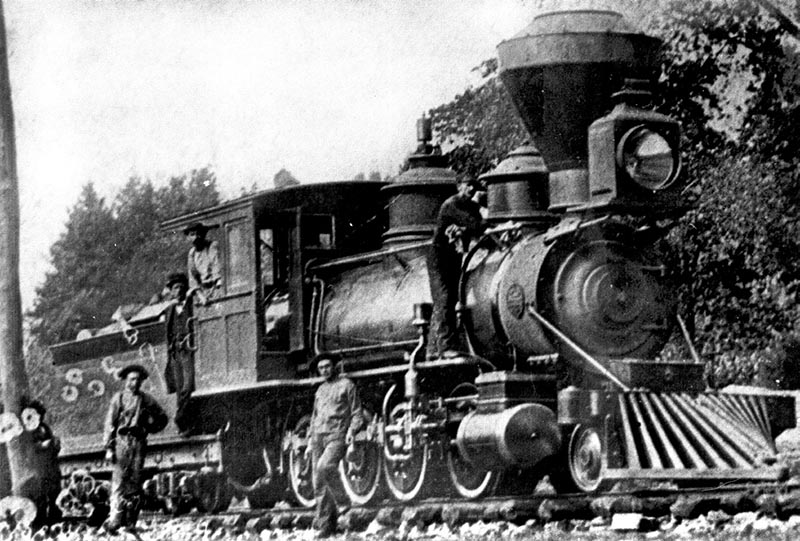
ABOVE: ET&WNC No. 3 in the 1880s as a wood burner.
History
The East Tennessee & Western North Carolina Railroad was organized in 1866 to build a 5’ gauge railroad from Johnson’s Depot, Tenn., on the East Tennessee & Virginia (later Southern Railway) to the iron ore mine at Cranberry, N.C. Surveys were done and work began using bonds from the state of Tennessee. Construction ended in 1868 after about 10 miles were graded and four miles of track was laid. An investigation found that the bonds had been improperly obtained, so the railroad was sold at public auction. The only bidders were the original owners but they were unable to secure any funding to continue construction. The right of way sat from 1868 to 1875 with no progress made.
That finally changed in 1875, when the Cranberry Iron & Coal Corporation was formed to purchase the mine and the railroad. The organizers were Philadelphia men who had just completed the East Broad Top Railroad in Pennsylvania. The EBT was an early success story in the narrow gauge movement and the investors wanted to repeat the process down south. Unfortunately, the state of Tennessee had a law in place that only allowed railroads of the southern standard gauge (5′) to be built. It took a few years of lobbying (palm greasing) by a former Confederate general to get the law changed.
Construction on the narrow gauge ET&WNC finally began in late 1880. Using most of the original grading, the line opened to Hampton, Tenn., (14 miles) by August 1881. The next section was far more complicated, running through the Doe River Gorge, considered one of the most rug-ged gorges in the east. Construction work was pushed through the winter months, and the ET&WNC opened for business to Cranberry, N.C., on July 4, 1882…
